How to Run an AI SDR Pilot: A 30-Day Plan for Judging It Fairly
Most AI SDR pilots are judged on the wrong week with the wrong numbers. A 30-day plan: what to prove, how to brief it, what to measure, and when to stop.

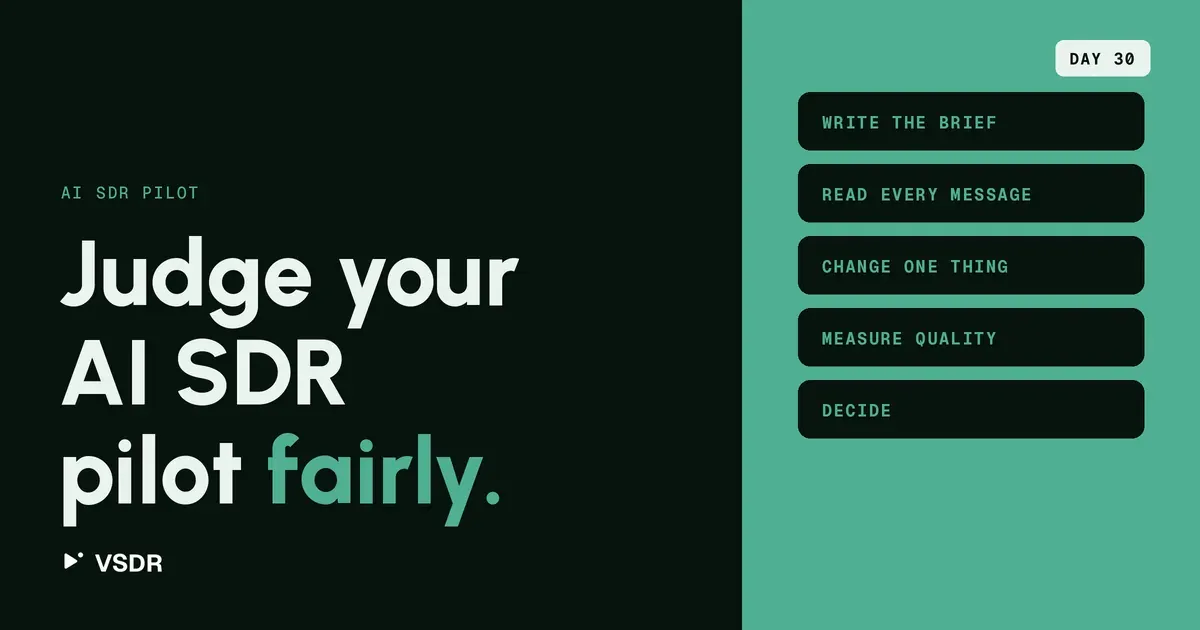
Most AI SDR pilots end with a shrug. Someone switches on a seat, points it at a loose list, checks the dashboard twice in the first week, and decides it “did not really work” or “seemed fine”. Neither verdict is a decision. Nobody agreed what the pilot was meant to prove, so nothing it produced could prove it.
A pilot is a small, deliberate experiment. You pick one question, one segment and one or two channels, write the brief properly, read what the agent sends, and judge the result against a baseline you trust. Done that way, thirty days is usually enough to know whether to scale, extend or stop.
Decide what the pilot has to prove
Write the question down in one sentence. A good one sounds like this: “Can an agent seat start qualified conversations with operations leaders at mid-size logistics firms, at a quality we would be happy to put our name to, with less than an hour a day of our time?”
That sentence does three jobs. It fixes the segment, so nobody widens the list halfway through. It names quality as a pass condition, not just volume. And it puts a ceiling on human effort, which is the real cost you are testing against.
Avoid questions you cannot answer in a month. “Will this double our pipeline” depends on deal cycles, pricing and a dozen things the pilot does not touch. “Will prospects in this segment reply to it, and are the replies worth having” is answerable.
Pick one segment and the right channels
Choose a segment you already know well, where you have sold before and can tell a good reply from a polite brush-off. Testing an agent and a new market at the same time leaves you unable to say which one failed.
Then choose channels on purpose. LinkedIn is the natural first touch for most B2B segments, because a stranger can see who you are before replying. WhatsApp suits segments where prospects already use it for work and have a reason to hear from you, usually after a LinkedIn conversation has started. If you want to test the handover between the two, run both. Our LinkedIn outreach and WhatsApp outreach pages explain how each channel is run.
On VSDR pricing, each outreach seat runs one channel. Starter includes one seat at $97 a month with extra seats at $39, and Pro includes two seats at $177. A two-channel pilot therefore needs two seats, so price that, not the headline figure.
Write the brief before day one
The agent works from what you give it. A thin brief produces generic messages, and generic messages fail for reasons that have nothing to do with the agent. Before launch, write down:
- The ICP in plain terms, with job titles, company size, region and the problem you solve for them. Our guide to defining an ICP for outbound covers how tight to make it.
- Exclusions: customers, open deals, partners and anyone sales already owns.
- Claims you can back up, and the ones you never make.
- Tone and language, including the languages your prospects actually reply in.
- Escalation rules: which replies the agent may answer, and which go straight to a person. Our post on AI SDR guardrails has a starting list.
Week one: the trial week is for reading, not judging
Every paid plan starts with a 7-day free trial and no lock-ins. Use those seven days to set up and to read, not to decide.
Read every message the agent sends in the first days. You are checking for three things: does it describe your offer accurately, does it sound like your company, and does each message have a real reason for writing to that person. If any of the three is off, fix the brief, not the individual message. Step into any thread yourself whenever you want, and note each time you did and why.
At the end of the week, ask one question: is this good enough to keep running for three more weeks? That is a quality call, not a results call. Very few replies will have come in yet, and that is normal.
Weeks two and three: hold steady and log everything
The temptation in week two is to change everything at once. Resist it. Change one thing at a time, write down what you changed, and give it a few days.
Keep a simple log with four columns: date, what the agent did, what you changed, and what you saw. It turns the final review from a matter of opinion into a conversation about evidence.
Read replies as they arrive. The early signal is qualitative. Are the right people answering? Are they answering the question the message asked? Are the objections the ones your team hears on calls? Our post on how an AI SDR should handle replies covers what good handling looks like and when a person should take over.
What to measure
| Measure | What it tells you | Watch out for |
|---|---|---|
| Messages you had to correct | Whether the brief is working | Corrections should fall over the month |
| Replies from the right roles | Whether the targeting is right | Polite replies from the wrong people |
| Positive or curious replies | Whether the angle lands | Counting “not now” as positive |
| Meetings booked and held | Whether conversations convert | Small numbers in a month, so read each one |
| Time your team spent | The real cost | Hidden time spent rewriting messages |
Leave out what does not predict meetings: messages sent, profile views, connection requests on their own. They are easy to count and say little about whether the pilot worked.
Compare against your own baseline
The most useful comparison is with what your team already gets from the same segment: your SDRs, your sequences, or a previous campaign. Pull those numbers before the pilot starts, for the same kind of prospects, so nobody adjusts them afterwards.
Industry averages are a poor yardstick. They mix segments, channels and definitions of “reply”, and they tell you nothing about your market. If you have no baseline, say so, and judge the pilot on reply quality and the time it took rather than inventing one.
Make the call at day thirty
Decide in one meeting, with the log and the table in front of you. Three outcomes are possible:
- Scale when the agent produced qualified conversations at a quality you are happy with and your team’s time stayed within the limit you set. Add a segment or a channel next, one at a time.
- Extend when quality is good but the segment is slow, or when the brief changed late and has not had time to work. Set a second, shorter window with a specific question.
- Stop when the messages still needed heavy correction at the end of the month, or when the right people engaged and still did not want a conversation. That second case is often a message or market problem, not an agent problem, and it is worth knowing either way.
Where a pilot does not work
A thirty-day pilot cannot judge a channel in a market of a few dozen accounts. You will run out of prospects before you have learned anything, and each wasted first touch is expensive. In very small markets, personal outreach from your own team is usually the better test.
It also cannot measure closed revenue when your sales cycle runs for months. Judge on leading signals, meaning the right people replying and meetings held, and agree up front that revenue comes later.
And it does not work if nobody owns the replies. An agent can start conversations and handle routine answers, but a prospect who asks for a call needs a person who turns up. If nobody on your team has time for that this month, delay the pilot rather than run it badly.